About the project

Eco-industrial parks

Welcome to South Africa’s knowledge hub on eco-industrial parks (EIPs) or industrial spaces. This is a free platform where EIP enthusiasts, researchers and practitioners can register free of charge and gain access to a knowledge repository on planning, developing and assessing EIPs in South Africa.

The EIP concept is about creating resource efficient and cost-effective industrial parks that are more competitive, attractive for investment, and risk resilient.

The number of EIPs is rapidly increasing, both nationally and internationally. The transformation of traditional industrial parks into EIPs or industrial spaces presents a valuable opportunity to tackle economic, environmental, and social challenges and capitalise on opportunities for sustainable industrial development.

The first phase of the Global Eco-Industrial Parks Programme (GEIPP) is implemented in three industrial spaces in South Africa – East London Industrial Development Zone (SEZ), Phuthaditjhaba Industrial Park, and Ekandustria, while EIP-assessments and related activities have been conducted in a number of additional parks.

Industrial Spaces Assistant

The EIP approach

An industrial space is a complex ecosystem that involves multiple stakeholders and operational dimensions such as production, customer relations, procurement, continuous planning, business development, marketing, branding, support, services, capacity building, compliance, reporting and so on. Industrial development can be a catalyst for sustainable (social, economic, environmental) development that also considers climate change, global warming, GHG emissions and biodiversity loss.

Industrial spaces in the national context include any area of industrial activity and under the reimagined approach for industrial spaces in South Africa, the aim is to transition these spaces into sustainable industrial spaces by way of the Eco-Industrial Park (EIP) approach that is based on the International EIP Framework developed by UNIDO, GIZ and the World Bank. This transition to an EIP needs to follow a systems approach, addressing multiple dimensions and demonstrating high levels of complexity and integration of components such as governance, operations, services, compliance and reporting.

By its very nature, the EIP approach is a collaborative approach that requires a high measure of coordination, alignment and collaboration between the various components of the system at the level of the industrial space itself and also at regional and national level. The EIP work in South Africa is closely aligned with the industrialization agenda of the dtic and is implemented through national programmes such as the Global Eco-Industrial Park Programme (GEIPP).

GEIPP-SA

The GEIPP is implemented by the United Nations Industrial Development Organization (UNIDO) and funded by the Switzerland government through its State Secretariat of Economic Affairs (SECO) to green industrial parks by improving resource productivity and economic, environmental, and social performances of businesses in seven countries: Colombia, Egypt, Indonesia, Peru, South Africa, Ukraine and Vietnam.

UNIDO selected the National Cleaner Production Centre South Africa (NCPC-SA) to implement South Africa’s in-country GEIPP interventions. In partnership with UNIDO and the Department of Trade, Industry and Competition (the dtic), the NCPC-SA launched GEIPP-SA in 2020.

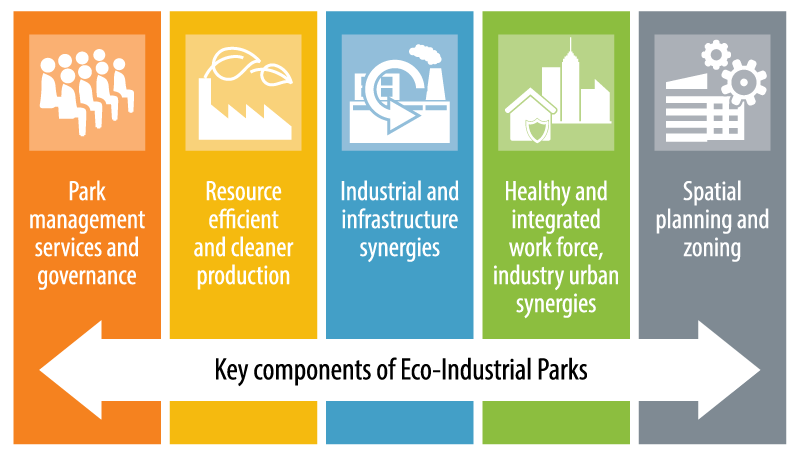
GEIPP-SA is guided by an approach developed by UNIDO in creating EIPs through the following components:

  • Park management services and governance;
  • Resource efficiency and cleaner production;
  • Industrial and infrastructure synergies;
  • Healthy and integrated workforce, and urban-industrial synergies; and
  • Spatial planning and zoning.

GEIPP-SA is piloting the EIP approach at three industrial parks and has assessed six additional parks for inclusion into the programme. The programme capacitates the parks with various resource efficiency and cleaner production (RECP) interventions, including online workshops.

GEIPP-SA also supports the Industrial Park Revitalisation Programme (IPRP) of the dtic, matching the core focus areas of economic, social, and environmental benefit to support the national priorities to address poverty, employment, inequality, and growth.

GEIPP-SA Partners

  • Council of Scientific and Industrial Research (CSIR)
  • Department of Trade, Industry and Competition (the dtic)
  • Deutsche Gesellschaft für Internationale Zusammenarbeit (GIZ)
  • National Cleaner Production Centre South Africa (NCPC-SA)
  • Switzerland: State Secretariat of Economic Affairs (SECO)
  • United Nations Industrial Development Organization (UNIDO)

The EIP concept dates back to the early 1990s, with the uptake increasing in 2018. UNIDO defines an EIP as a community of businesses located on a common property where they seek to achieve enhanced environmental, economic and social performance through collaboration by managing environmental and resource issues. While this sounds like what typically defines the traditional industrial park model, the EIP approach goes much more beyond that.

UNIDO, in partnership with the World Bank and GIZ, developed the international EIP framework which was first published in 2017. The framework describes the performance requirements for EIPs grounded in four key categories:

  • Park management performance;
  • Environmental performance;
  • Social performance; and
  • Economic performance.

The EIP approach encourages collaboration and coordination among various stakeholders to address sustainability (economic, environmental and social dimensions) in an industrial space. This includes planning, shared facilities, industrial symbiosis, joint activities, value-added services and so on and is based on the precept that the whole is greater than the sum of the parts. It is a systems-approach that aims to leverage the value of the multiple components of such a system for the benefit of all involved (win-win outcomes).

The EIP approach also embraces community collaboration thereby fostering inclusive and sustainable development and in so doing addresses national priorities relating to poverty, employment, inequality and growth. A key advantage of the EIP approach is that it can be adopted by new or existing industrial spaces.

The benefits of EIPs

  • Greater collaboration between companies, government and service providers. i.e. inclusion of industrial spaces in government master plans and Local Economic Development (LED).
  • Tenant companies and park management are able to turn environmental, social and economic problems into solutions.
  • The industrial space is capacitated for increased competitiveness and business development.
  • Improved resilience and production continuity.
  • Better reputation with key stakeholders and greater attractiveness to potential investors.
  • Improved cost effectiveness and operations resulting in profitability improvements.
  • Collaboration with surrounding communities and integration into social development.
  • Increased opportunities for new services and products that provide not only economic value, but also environmental and social value.
  • More structured approach to support the Nationally Determined Contributions (NDCs) under the Paris Agreement, SDGs, Just Transition and other such interventions.
  • Structured participation by industry in environmental regeneration and combatting biodiversity loss and climate change.
  • Industrial synergies through which companies benefit from greater collaboration.
  • Reduced environmental impact through resource-efficient and cleaner production (RECP) practices.

Partners

NCPC Assistant

Quick prompts

Your conversation will appear here. Use a quick prompt above or type a message below.